
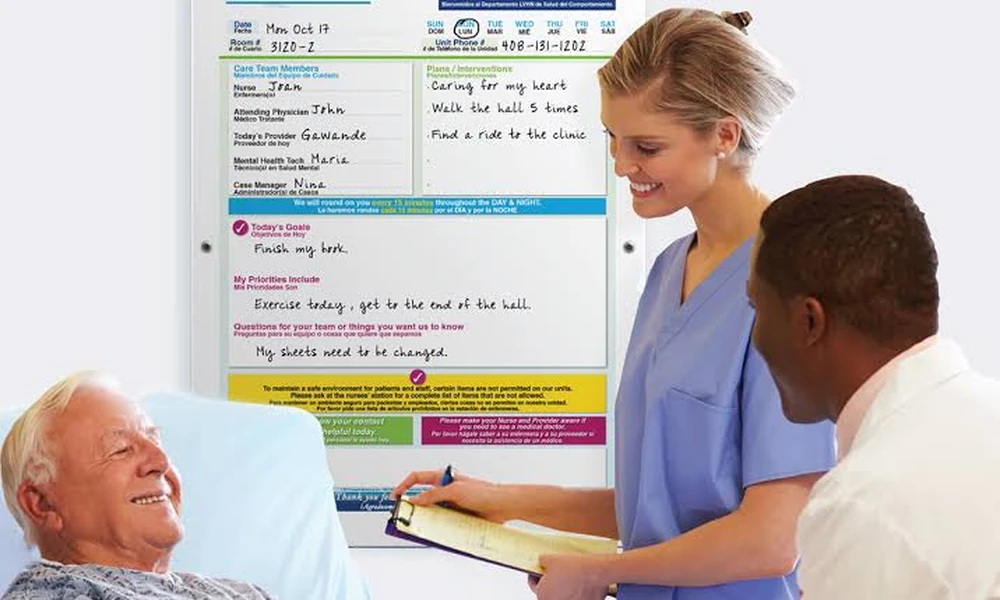
Communication failures are one of the most persistent risks in hospital care. Breakdowns in communication are among the most frequently identified root causes of sentinel events reviewed by the nation’s leading hospital accreditor (The Joint Commission). Simple, visible tools that keep patients, families, and care teams on the same page have become a standard part of patient room design as a result.
What role do whiteboards play in patient rooms?
Whiteboards give every person in a patient room a shared, current reference point. They typically display the care team’s names, the plan for the day, pain goals, and expected discharge timing. Nurses and physicians update the board during rounds, and patients and families can see changes without waiting for the next conversation.
What information do hospitals typically display?
Hospitals commonly include four types of information on patient room boards:
- Names of the nurse, physician, and care team members
- Daily goals and scheduled tests or procedures
- Pain levels and comfort priorities
- Anticipated discharge date and family contact notes
Which surface features matter in clinical environments?
Surface features matter because clinical boards are written on and disinfected many times a day. Healthcare whiteboards are now built with porcelain surfaces described as antimicrobial, nonporous, and easy to clean, in custom sizes from 24 by 36 inches to 48 by 96 inches and beyond (ASI Visual Display Products). That combination allows boards to match room layouts while standing up to hospital-grade cleaners.
Why does a nonporous surface matter for infection control?
A nonporous surface matters because it does not absorb ink, moisture, or residue. On any given day, about one in 31 hospital patients has at least one healthcare-associated infection (Centers for Disease Control and Prevention), so every high-touch surface in a patient room benefits from materials that clean completely.
Should boards be magnetic?
Magnetic boards let staff attach preprinted cards for recurring information such as fall risk or diet orders. That saves time during busy shifts and keeps handwritten content focused on details that change daily.
Do whiteboards improve patient understanding?
Whiteboards can improve patient understanding of who is caring for them. In a hospital study, patients in rooms with whiteboards were more likely to correctly identify their physicians (Journal of Hospital Medicine). Knowing the care team by name helps patients ask questions and report concerns to the right person.
How do boards support family engagement?
Boards support family engagement by giving visitors information they would otherwise need to request from staff. Federal patient safety resources encourage hospitals to involve patients and families as partners in care (Agency for Healthcare Research and Quality), and a visible board is one of the simplest ways to do that.
How should hospitals standardize board layouts?
Hospitals should standardize layouts across units so staff know exactly where to write each item. Custom printed templates with consistent fields reduce missed updates and make boards easier to read from the bed. Placement should keep the board visible from the patient’s line of sight.
Where else in the hospital do boards support communication?
Boards support communication well beyond patient rooms. Nurse stations use large boards for staffing assignments and bed status, operating rooms use them for case schedules, and emergency departments use them for triage and tracking. Behavioral health and rehabilitation units often require tamper-resistant and impact-resistant boards that provide added safety in sensitive settings.
How do nurse station boards help shift handoffs?
Nurse station boards help shift handoffs by keeping assignments, pending tasks, and patient flow visible to the incoming team. A shared view reduces the chance that an important detail is lost between shifts and gives charge nurses a quick picture of unit status.
What should design teams prioritize?
Design teams should treat patient room whiteboards as clinical communication tools, not decoration. Durable, cleanable porcelain surfaces, sized and templated for each unit, help hospitals support safety, engagement, and the daily rhythm of care.