
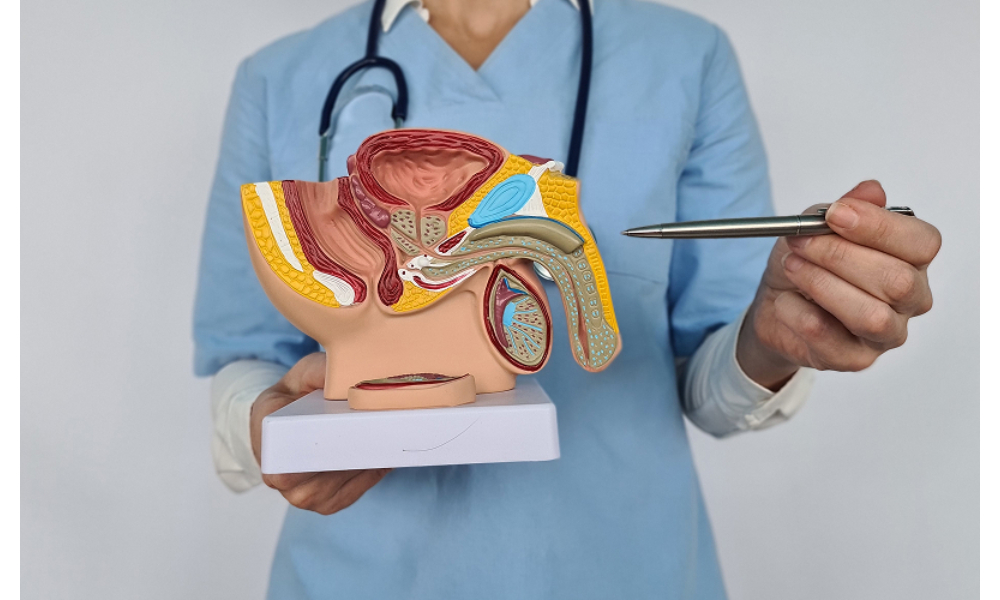
Contemporary prostate cancer treatment pathways in Singapore start with precise staging and a documented functional baseline. Multiparametric MRI is used to map tumour location, capsular contact, and proximity to neurovascular bundles; in appropriate cases, PSMA-targeted imaging refines extra-prostatic risk. Functional assessment records baseline International Index of Erectile Function scores, urinary function, cardiovascular status, and medications that influence sexual performance. Establishing these pre-operative parameters allows realistic counselling on erectile function trajectories and informs the choice and extent of nerve preservation during surgery.
Nerve-Sparing, But With Oncological Control First
Erectile function after radical prostatectomy depends largely on preserving the cavernous nerve fibres travelling within the neurovascular bundles. Modern plans grade nerve-sparing laterally by side (bilateral, unilateral, partial, or nerve-sparing) according to MRI, biopsy mapping, and intraoperative findings. Surgeons increasingly use athermal techniques along the prostatic fascia to limit thermal spread to the nerves. This involves substituting tools like cold scissors and clips for extended cautery. Clipless approaches and selective traction minimisation aim to reduce neuropraxia. Where margin risk is uncertain, intraoperative frozen-section analysis of the posterolateral margin (often termed a “NeuroSAFE-style” workflow) can guide immediate adjustment: if a positive margin is detected, further resection is performed while still attempting to conserve functional fibres where oncologically safe.
Robotic Technique Refinements Affecting Continence And Potency
Robotic-assisted radical prostatectomy is widely adopted, with refinements that indirectly support erectile recovery by stabilising early healing. Retzius-sparing dissection (posterior approach) preserves anterior supporting structures and may facilitate earlier continence; bladder-neck preservation and posterior–anterior reconstruction help recreate the sphincteric support. Although these steps target continence, reduced oedema, and improved early pelvic mechanics, they can favour earlier initiation of sexual rehabilitation. High-definition optics and articulated instruments allow closer fascial plane dissection around the neurovascular bundles, potentially reducing traction and crush injury. Indocyanine green fluorescence is used in some centres to visualise arterial flow in the bundles before finalising dissection planes.
Managing Margin Risk Without Abandoning Function
The trade-off between cancer control and function is addressed by side-specific strategies. If one side shows MRI–pathology concordance with low extracapsular risk, full nerve-sparing may be performed there, while the contralateral side is down-staged to partial or nerve-sparing when contact or capsular bulge is suspected. This side-by-side tailoring often yields better functional recovery than blanket non–nerve–sparing, without compromising negative margin goals. When postoperative pathology reveals adverse features, early adjuvant or salvage radiotherapy is planned with attention to cumulative functional effects, and the rehabilitation protocol is recalibrated accordingly.
Immediate Post-Operative Pathway: Enabling Early Rehabilitation
Enhanced recovery protocols standardise analgesia, early mobilisation, and catheter timelines. Early pelvic floor training begins as soon as feasible, because continence gains make sexual rehabilitation practical. A key shift in erectile dysfunction treatment in Singapore is to start penile rehabilitation on a schedule rather than wait for spontaneous recovery. Protocols commonly deploy daily or alternate-day low-dose phosphodiesterase type-5 inhibitors (PDE5i) soon after catheter removal, with on-demand dosing layered for sexual attempts. The aim is to maintain nocturnal and induced cavernosal oxygenation, limiting smooth muscle apoptosis and fibrosis during nerve recovery.
Structured Penile Rehabilitation: Staged, Data-Driven, And Time-Bound
A staged algorithm is used to avoid therapeutic drift:
- Weeks 2–12: PDE5i education and dose–timing optimisation; vacuum erection device (VED) introduced for daily negative-pressure conditioning independent of sexual activity. Patients are shown how to use the VED without constriction rings for conditioning sessions to reduce ischaemic time.
- Months 3–6: If rigidity remains inadequate despite correct PDE5i use, intracavernosal injection (ICI) therapy is added with structured in-clinic titration and clear safety rules (dose limits, priapism management). At this stage, some programmes trial low-intensity extracorporeal shockwave therapy in strictly selected vasculogenic profiles, with the patient counselled that evidence for durability varies.
- Months 6–12+: For persistent non-response, candidacy for penile prosthesis is evaluated once oncological surveillance is stable. Discussion covers device selection, infection precautions, mechanical reliability, and expectations for concealability and activation.
At each step, cardiovascular risk and medications are re-reviewed. PDE5i are contraindicated with nitrates; alpha-blockers and antihypertensives require spacing and blood-pressure monitoring. Diabetes and dyslipidaemia are optimised to improve endothelial responsiveness.
Adjuncts That Matter: Counselling, Partner Involvement, And Sleep
Beyond devices and drugs, practical adjuncts influence outcomes. Patients receive guidance on realistic timelines (nerve recovery commonly extends 6–24 months), the impact of sleep quality and REM-associated tumescence on tissue health, and the value of partner-inclusive counselling to maintain adherence. Where anxiety or avoidance patterns emerge, early psychological support is offered; unaddressed performance anxiety can suppress response even when physiological capacity returns.
For imaging-guided surgical planning and structured rehabilitation integrating prostate cancer treatment with erectile dysfunction treatment in Singapore, contact the National University Hospital (NUH).